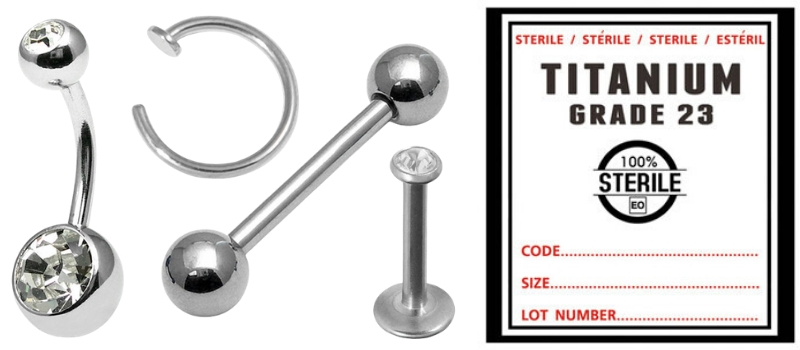
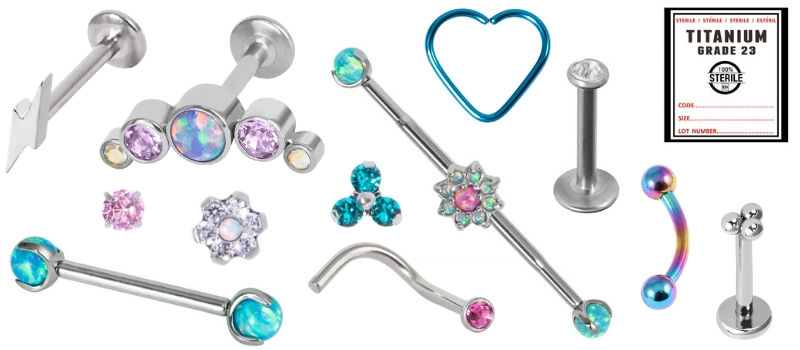
What is TDi Titanium Body Jewellery Made From?
TDi Titanium body jewellery is made from Implant Grade 23 (Ti6Al4V ELI, ASTM F136) Titanium. It’s 3 times stronger than steel, is biocompatible, lightweight and ideal for new and healed piercings.
Is Titanium Body Jewellery Safe?
Titanium is biocompatible which means it’s safe to use with living tissue (that’s you!) by being non toxic, non reactive and causes no immunological rejection. Implant Grade 23 Titanium is used extensively by the British and American medical associations for implants due to its total resistance to attack by body fluids.
Implant Grade 23 Titanium is the professional piercer’s material of choice for your piercing jewellery.
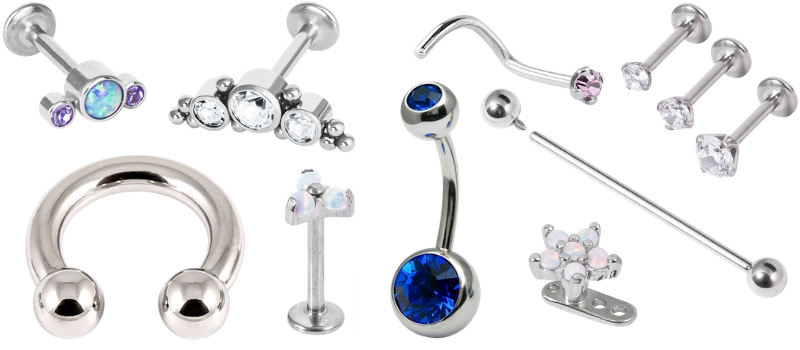
Is Titanium Body Jewellery Hypoallergenic & Nickel Free?
Titanium is nickel free and hypo-allergenic. All TDi Titanium body jewellery conforms to the EC Nickel Directive. As does all TDi body jewellery no matter which material it’s made from.
Suitable for initial (unhealed) and healed piercings
Titanium – Implant Grade 23 (Ti6Al4V ELI, ASTM F136)
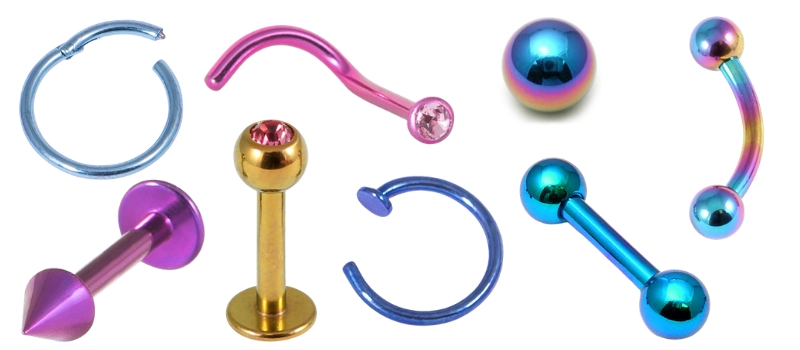
How Do You Colour The Titanium?
Titanium can be anodised to give many vibrant colours. Titanium is anodised using an electrolysis process; this process adjusts the oxide level on the surface of the metal. This change in the oxide level controls the light refraction and therefore the colour of the surface metal. By carefully adjusting the oxide level you can control the colour of the metal surface.
The surface colour of the anodised product is an integral part of the metal product, not a coating, and is just as bio-compatible.
Where Does Titanium Come From?
Titanium is the 4th most abundant structural metal on earth. It can only be found as a variety of ores; a naturally occurring rock or sediment from which a metal or mineral can be extracted. These ores must undergo a multi-step process in order to extract the titanium metal.
Titanium Fast Facts!
Titanium was named after mythological Greek giants – the titans.
Titanium is three times as strong as steel and twice as strong as aluminium .
Titanium weighs much less than steel, making it both really strong and lightweight, perfect for piercings!
Check out our Titanium Body Jewellery online now!
We also have a range of Sterile Titanium, that’s pre-sterilised and ready to use in your piercing.